

The Carbon Currency: How Central Banks Are Quietly Monetizing the Climate Transition
- theconvergencys
- Nov 9, 2025
- 4 min read

By Leo Zhang Jun. 8, 2025
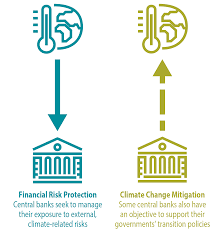
In 2025, the European Central Bank (ECB) announced that carbon-intensive assets would face higher collateral “haircuts” in monetary operations. It sounded technical—but it marked the quiet birth of a new economic order. Central banks, once guardians of price stability, are becoming architects of climate policy. According to the Bank for International Settlements (BIS 2024), more than 70 percent of central banks now integrate environmental risk into monetary frameworks. What was once the domain of ministries and activists has entered the balance sheets of the world’s most powerful financial institutions.
The Logic of Green Monetary Policy
Traditional monetary policy treats all capital as neutral. But in a carbon-constrained world, neutrality is distortion. The Network for Greening the Financial System (NGFS 2024) argues that climate change creates “double materiality”—where environmental risk feeds financial instability, and vice versa. Floods destroy assets, emissions inflate liabilities, and droughts shift commodity prices.
To hedge this systemic risk, central banks are “tilting” portfolios toward sustainable assets. The ECB’s Climate Action Plan (2024) rebalances its corporate bond holdings based on issuers’ carbon footprints. Similarly, the People’s Bank of China (PBoC) offers preferential refinancing rates for green lending, reducing borrowing costs for renewable projects by up to 150 basis points.
These interventions blur the line between monetary neutrality and industrial strategy.
From QE to GQE—Green Quantitative Easing
Quantitative easing once aimed to stimulate economies after crises. Now, a new generation of “Green QE” channels liquidity directly into climate-aligned investments. The Bank of England’s Green Finance Initiative (2024) injected £20 billion into sustainability-linked bonds. Japan’s central bank expanded its climate lending facility to ¥15 trillion, supporting corporate decarbonization.
Yet critics warn of unintended distortions. A London School of Economics (2024) study found that 60 percent of green bond issuances financed corporate debt rollover, not new investment—raising concerns that Green QE may simply “repaint” existing capital green.
The Carbon Collateral Problem
Carbon exposure is now a form of credit risk. The European Systemic Risk Board (ESRB 2024) calculates that a sudden repricing of fossil-fuel assets—often called the “carbon bubble”—could wipe US$2.7 trillion from global balance sheets. If central banks hold these securities as collateral, monetary stability itself becomes carbon-dependent.
In response, the Swiss National Bank (SNB) has begun applying “carbon haircuts” to repo operations, discounting collateral based on emissions intensity. The Bank of France goes further, excluding coal-linked firms entirely. Such measures effectively assign a shadow carbon price within monetary systems—monetary policy as climate policy by stealth.
The Emerging Carbon Currency
A parallel financial architecture is forming. The European Investment Bank (EIB) and Asian Development Bank (ADB) have begun issuing bonds denominated in “carbon-adjusted units,” where yield correlates inversely with emissions performance. Investors effectively buy decarbonization exposure, not just credit risk.
Some economists envision a “carbon currency”—a unit of account linked to verified emission reductions. The IMF Special Drawing Rights (SDR) Green Reform Proposal (2025) explores adding carbon performance as a weighting factor in reserve currency composition. If implemented, the dollar’s dominance could one day depend as much on carbon efficiency as on GDP.
The Politics of Green Mandates
Central banks were designed to be technocratic, not political. Yet the climate transition is inherently redistributive—it determines winners and losers across industries and nations. The BIS Annual Economic Report (2024) warns that green mandates could expose central banks to accusations of “mission creep.” In the U.S., the Federal Reserve remains cautious: Chair Jerome Powell reiterated in 2024 that the Fed “does not and will not act as a climate policymaker.”
But abstention is itself a policy. The Fed’s continued purchase of fossil-fuel-linked assets through index funds indirectly sustains carbon-intensive sectors. As economist Daniela Gabor observes, “monetary passivity is political activity by default.”
Toward a Climate Lender of Last Resort
Climate disasters will increasingly require central banks to intervene as “lenders of last resort” for environmental crises. After the 2023 floods in Germany, the Bundesbank created emergency liquidity windows for affected businesses. The Reserve Bank of India (RBI) launched similar facilities following cyclone damage in Gujarat.
These are prototypes of a new monetary frontier—where stability is measured not only in inflation rates but in degrees Celsius. The green transition is, fundamentally, a monetary transition.
The Future of Climate Capitalism
Central banks once printed money to rescue markets. Tomorrow, they may print resilience to rescue the planet. The challenge is balance: mobilizing credit for decarbonization without creating new bubbles of speculative “green exuberance.”
If money is a claim on the future, then the future’s stability now depends on how we price carbon within it. The next Bretton Woods may not be negotiated in gold—but in gigatons.
Works Cited
“Central Banking and Climate Change.” Bank for International Settlements (BIS), 2024.
“Climate Action Plan.” European Central Bank (ECB), 2024.
“Monetary Policy and the Green Transition.” Network for Greening the Financial System (NGFS), 2024.
“Green Finance Initiative Report.” Bank of England, 2024.
“Systemic Risk from Fossil Asset Repricing.” European Systemic Risk Board (ESRB), 2024.
“Carbon Haircut Framework.” Swiss National Bank (SNB), 2024.
“Green Bond Market Analysis.” London School of Economics Sustainable Finance Centre, 2024.
“Green Reform Proposal for SDRs.” International Monetary Fund (IMF), 2025.
“ADB Green Lending Facility Report.” Asian Development Bank (ADB), 2024.
“Annual Economic Report.” Bank for International Settlements (BIS), 2024.


Comments